The Follies of the Western Mind

Arktos, 2025
What is thinking? What calls on us to think? Who decides what’s good and bad? Do modern societies understand the meaning of peace? Has science become closed-minded? Does freedom mean the same for everyone? How does language affect the way people think? Is it possible to understand consciousness? Is humanity on a collision course with destiny?
A book about thinking. It’s not a philosophy book, a spiritual book, or a medical book, though it’s a little bit of each. It’s mostly about how people in the West think, and about how they don’t think.
Thinking in the West has become boxed-in, inflexible and blinkered. Like a deep-sea diver’s suit, Western thinking is weighed down, with an outlook in only one direction. Western minds have become trapped, while another world exists outside.
The book doesn’t offer a way out of this prison of the mind. It offers instead some of the tools needed to escape, some hammers and spanners to pry open the bars.
Escaping the West’s mental trap requires people to see the world a little differently, to question deeply held beliefs and ideas. It requires them to understand that the way they view the world is not the only way. It requires them to see that there are alternatives, and that some of these might actually be better.
Introduction
Foreword
A chicken can’t lay a duck egg

Changemakers Books, 2021
“Bold, dramatic, and visionary. I hope humanity is up to the challenge.” Jorgen Randers, Co-author The Limits to Growth (1972).
“This cry from the heart from two top policy insiders is a must read!” Hazel Henderson, futurist and an economic iconoclast.
“Buy ten much-needed copies, one for yourself and the rest for forward-thinking, committed, tough-minded, and effective friends who really want to save the world.” Daoist Monk Yun Rou.
“The authors contend that the only alternative to collective eco-suicide is a radical democratization of society. I couldn’t agree more. Young people, especially, should read this book!” Richard Smith, economic historian and author.
“A must read for every thinking person.” Prof Paul Shrivastava, Penn State University.
“Read and act on the wisdom of this book now. In another decade it will be too late.” Dr Susan George, President and Chairman of the Supervisory Board, Transnational Institute.
“An engaging and unsettling little book that makes a powerful case for urgent and fundamental social change.” Prof Mark B. Brown, California State University, Sacramento.
“Passionate about the realities; clear about the changes; funny when it needs to be. This book takes us from chaos to opportunity.” Martin Palmer, Secretary General, Alliance of Religions and Conservation.
“This book maps a communication pathway: get the facts straight, bust the myths, and speak out. A clarion call.” Dr Kerryn Higgs, University of Tasmania.
“Reading this book felt like having some smart, funny, and passionate people round for a dinner party where they explain things in a way that gets the point across while also being witty and engaging.” Dr. Nazanin Zadeh-Cummings, Deakin University, Melbourne.

Download the factsheet from the book.
Change! Why we need a radical turnaround
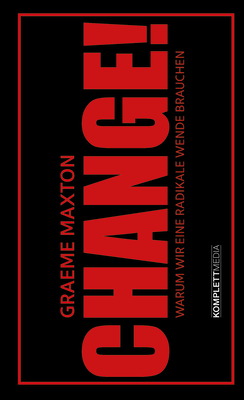
Komplett-Media 2018 and 2020, in German. Also in Slovak and Czech.
English edition
It is the defining battle of the 21st century and no Hollywood hero is coming to save us. In this radical and easy-to-read book the former Secretary General of the Club of Rome presents his manifesto for economic and social change. He shows how humanity can build a 20-year bridge to a better world.
There is no option but change.
Download the one page summary To do List or the proposals for change.
Download a pdf version of the book in English here. Epub version in English here.
Reinventing prosperity: Managing economic growth to reduce employment, inequality and climate change

Greystone Books, 2016, co-authored with Jorgen Randers
“The world faces a number of monumental challenges, ranging from persistent inequality and the ageing of population to climate change and the rise of the robot. In this innovative, accessible, and persuasive book, Maxton and Randers show that we don’t need revolutionary changes to meet these challenges. They tell us how big changes can be – indeed, can only be – achieved through a set of reforms that are moderate enough to be politically feasible in the short run. An essential guide to those who want to change the world for the better – and for certain.” Ha-Joon Chang, University of Cambridge
“A fascinating, data-rich look at some of the most fundamental questions our species has ever faced—and a striking argument for maturity over endless growth.” Bill McKibben, author of Deep Economy
“Do you want a cogent and accessible explanation of why our paramount policy goal of GDP growth is increasing unemployment, inequality and environmental destruction—while reducing welfare? Then read this informative book for both answers and better policies!” Herman Daly, Emeritus Professor, University of Maryland
“This book has the power to induce policy changes that are imperative for the creation of an equitable, peaceful and sustainable future for human society.”
Rajendra K. Pachauri, past-Chair IPCC
“An important contribution to the global debate about growth, equality, climate change, and the path to a viable human future.”
David Korten, author, When Corporations Rule the World
“The problems society faces to achieve a sustainable and desirable future are well-known, but solutions seem impossible. Maxton and Randers describe 13 politically feasible proposals that can actually solve these problems. A must read for anyone who wants to create a better world.”
Robert Costanza, Professor of Public Policy ANU, author of Ecological Economics


The biggest challenges facing the rich world today are persistent unemployment, widening income inequality, and accelerating climate change. Until now, most of the “solutions” to these problems have been politically unacceptable, in a world marked by short-termism and a desire for continuous economic growth.
In Reinventing Prosperity, Graeme Maxton and Jorgen Randers offer a radically different approach to economics and our notions of prosperity.
They trace the history of the developed world’s desire for continuous economic growth and examine the consequences—as well as those in the future—and offer 13 politically feasible proposals that would reduce unemployment, inequality, and the pace of climate change—and also allow for further economic growth, if society wishes.
Reinventing Prosperity has been published in German (Ein Prozent ist genug), Ukrainian, Slovak and Italian.
Reinventare la prosperita: Come usare la crescita economica per ridurre disoccupazione, disuguaglianze e fermare i cambianti climatici

In Reinventare la prosperità Graeme Maxton e Jorgen Randers avanzano tredici proposte – tra cui la riduzione dell’orario lavorativo e l’innalzamento dell’età pensionabile, la ridefinizione del lavoro retribuito e del sistema fiscale, che dovrebbe essere ripensato per favorire il lavoro a svantaggio delle grandi aziende e dei patrimoni, l’introduzione di un reddito minimo garantito e di una tassa sul carbonio e sul consumo di materiali – che sfidano le idee economiche prevalenti e dimostrano come ridurre disuguaglianze e disoccupazione, riportando lo sviluppo entro i limiti dei confini ecologici del nostro pianeta.
The End of Progress: How modern economics has failed us
Wiley, 2011
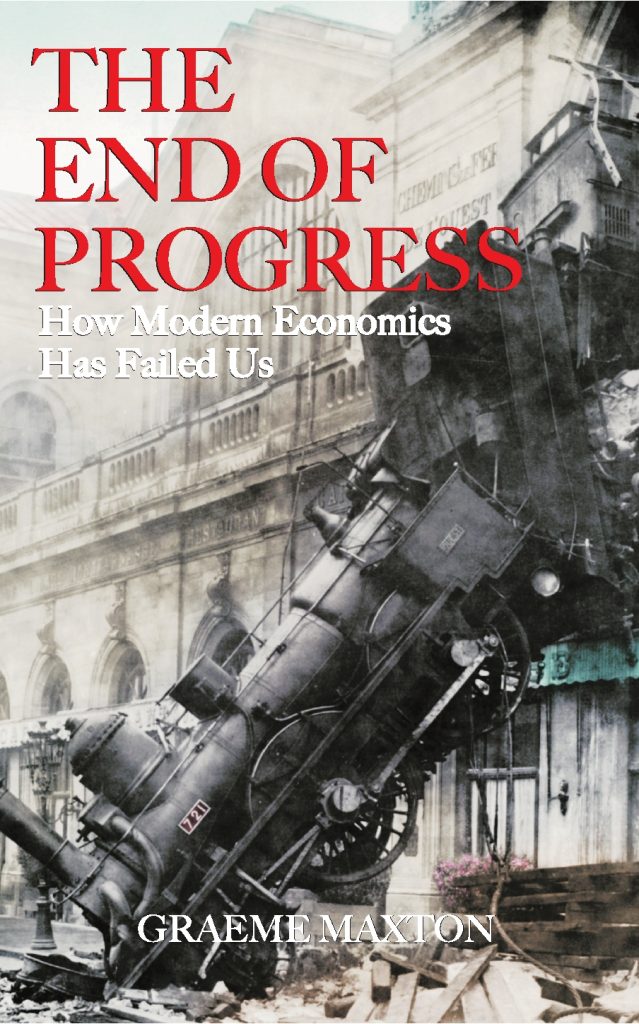
Nominated for the Financial Times Best Book About Business Award
“As Graeme Maxton’s important and entertaining book demonstrates, modern economic theory contains fundamental errors which any intelligent child could spot. This is not just an academic problem; we’ve left economists to run the world – and the planet is careening towards disaster as a result.” Richard Heinberg, Author
“Maxton is one of the first observers to note that world economic growth has reached hard limits. We ignore this shattering news at our peril. But if we can rid modern economic theory of a few fundamental and obvious errors, the a transition to a sustainable and satisfactory new economy is entirely feasible. The End of Progress is a vitally important and highly readable book – read it and have your eyes opened!” John Gapper, Financial Times
The German edition of the book was a Spiegel Top-20 bestseller.

Chinese edition
Czech edition
Romanian Edition
Time for a model change: Re-engineering the global automotive industry
Cambridge University Press, 2004
Cambridge University Press Feature Book of the Year
The automotive industry ranks among the most significant business phenomena of the 20th century and remains vitally important today, accounting for almost 11% of the GDP in rich-world countries, and nearly one in nine jobs. In economic and social terms, its products have had a fundamental impact on us all – for better or worse. Yet the industry has found it hard to respond to recent challenges and is not valued by capital markets as it once was. It has become riven by internal contradictions that inhibit reform. This book is a wake-up call which highlights the opportunities for those working in the business, in finance, as legislators and for new entrants. It offers everyone the chance to reflect on the value of our mobility today, and tomorrow.
“A powerful diagnosis and an imaginative blueprint for reform. The industry and everyone who depends on it would do well to take notice.” Sir Geoffrey Owen, London School of Economics
“A must-read for everyone in the automotive industry.” Ratan Tata, Chairman, Tata Sons
Written with Dr John Wormald.
A PDF copy of this book is available on request
Driving Over a Cliff? Business lessons from the world’s car industry
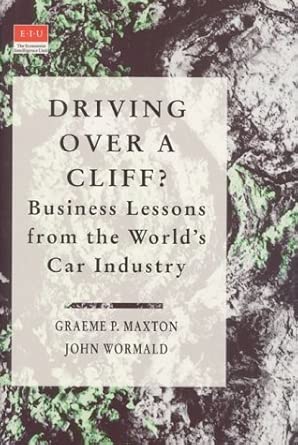
Addison Wesley, 1994
Nominated for the Financial Times Best Book about Business Award
The automotive industry is one of world’s largest and truly global businesses. It has had an incalculable impact on our lives, our societies, our cities and the modern industrial organisation. Like all industries it is subject to the laws of markets, economics and competition.
The industry also faces major new challenges – the rise of China, changes in technology and greater environmental regulation. It is also at the mature stage of its lifecycle.
- How should the industry move ahead?
- Where can it find growth?
- Who will be the winners and losers in the battle to come?
This lively and stimulating book is aimed not just at those in the industry or those who regulate it. It also provides valuable lessons in strategy for any business professionals, students as well as more general readership, for all those who want to understand a phenomenon that continues have a pervasive influence on all our lives.
Written with Dr John Wormald